2022 | 5 Weeks | Design Research | Academic | Project Guide Dr. Debjani Roy
Interactive storytelling for children
How do you design a bottom-up storytelling-based method that supports children's expression without directing it?
Conferences & Recognition

NAoP - National Conference
National Academy of Psychology (March 2023 at AU Ahmadabad, India)

IndiaHCI - International Conference
International Conference in HCI (November 2023 at UPES Dehradun, India)
This project looks at how storytelling helps children express themselves, and what that can reveal about their social worlds. Through a 3-stage storytelling probe, I studied how children express emotions and social experiences indirectly, and how that can inform the design of more thoughtful tools and methods.
Design Approach
01
Secondary Research
Literature review on children's development, emotional expression, and folklore storytelling traditions.
04
Primary Research
Field activities with children including 3-stage probes, story gathering, and contextual discussions.
02
Inquiry
Expert interviews with child psychologists and professional storytellers to define design objectives.
05
Analysis
Thematic mapping and patterns discovery through qualitative coding of storytelling sessions.
03
Probe Design
Iterative development of open-ended, non-leading storytelling probes for qualitative data gathering.
06
Design Direction
Synthesizing insights to inform the creation of interactive toolkits for parents and children.
Secondary Research
building inquiry

Mind map of concepts, literature reviews, and building inquiry.
Designing the Probe
I chose to work with a design probe because direct questioning felt limiting for this inquiry. I needed a method for inquiry that would let children express through making, talking, and storytelling.
The final probe moved away from predefined stories and characters. Children were given abstract shapes and asked to create two characters: one they like and one they dislike. This was followed by discussion and story building. This version felt the least suggestive, while still giving enough structure for expression to emerge.
The probe was tested and refined before the final study. This helped shape both the materials and the questioning.

Probe Development Journey
PHASE 01
Iteration 1
Used an existing story with given characters and a storyboard. This created engagement, but predefined elements restricted original expression.
PHASE 02
Iteration 2
Moved to generic characters and storyboards increased flexibility, yet fixed visual elements still influenced children's responses and biased their storytelling.
PHASE 03
Iteration 3
Abstract shapes and character creation allowed for the least suggestive probe, while still giving enough structure for expression to emerge.
Primary Field Research
Participants
5 Children
Age Group
5 to 7 Years
Session Length
2 hours
Stage 01
Creation of characters using abstract felt shapes, focusing on positive and negative associations.

Stage 02
Gathering stories where children narrated scenarios involving their created characters in social contexts.

Stage 03
Contextual discussions to explore underlying emotions and patterns in the children's narratives.

data gathered included:
Audio recordings of contextual discussions with children.
Audio recordings of the stories they narrated during the sessions.
Visuals and Transcriptions of characters created and sessions documented.


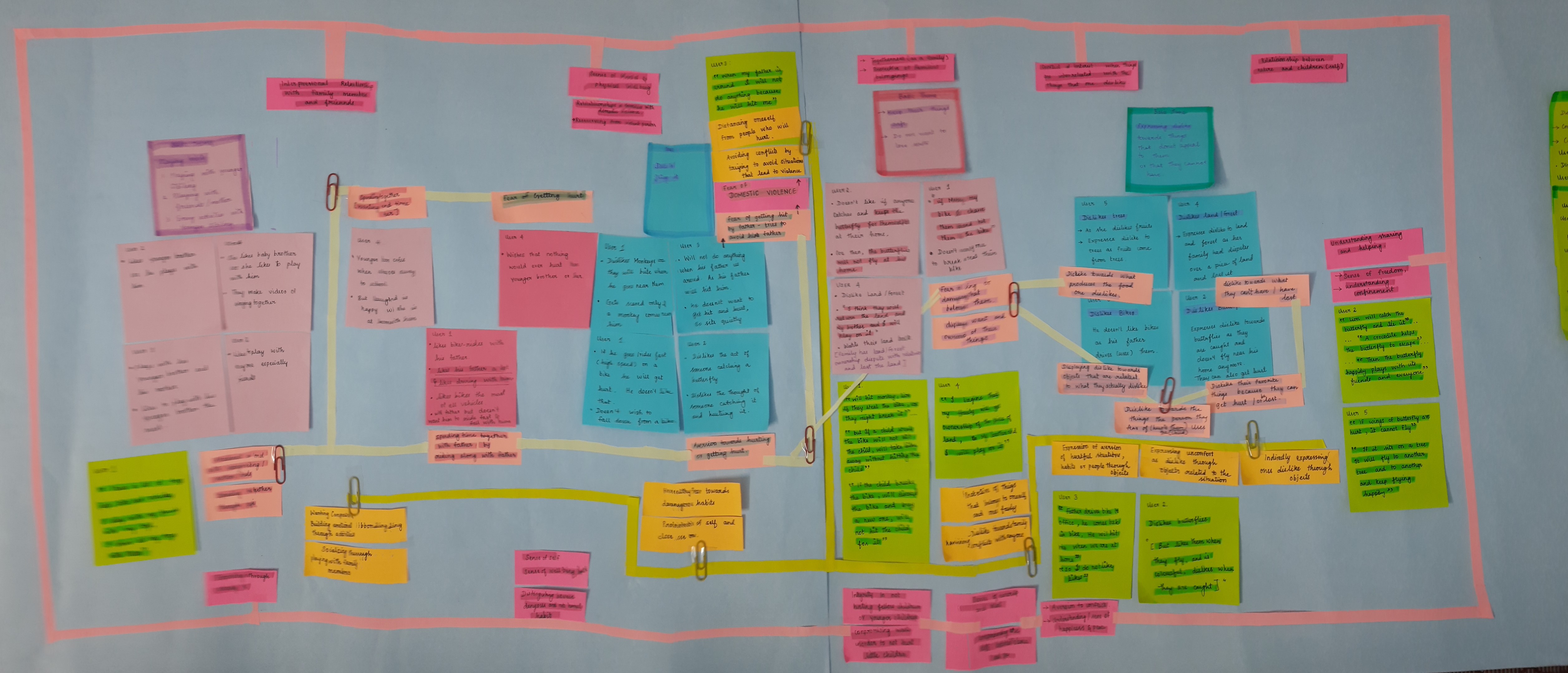
Thematic mapping of children’s stories and emotions
Analysis

Insights
Qualitative summary of the range of emotions the design probe elicits
The interconnections and themes and more emerged through thematic mapping. The individuality of the children was also evident once the data was analysed. The probe allowed children to connect with characters and engage in conversation through stories. The themes were implicitly and explicitly embedded in those narratives.


Quantitative summary
Quantitative data was derived from the qualitative analysis. This could enable visualization and an understanding of diversity or similarity in children of the same age who attend the same school. It highlights the effect of a child's environment where family plays a vital role in expressing and feeling certain emotions. Interaction methods have to be dynamic enough to cater to each child.
What This Informed
This pointed towards how interactive tools and methods can support children’s emotional expression.
INTERACTIVE EXPRESSION
The probe showed strong potential for interactive methods to support emotional expression. It also showed that indirect storytelling works well as a primary research/design lens for understanding children’s expression.
TOOLKIT THINKING
The research later informed the early direction of Close-Knit, a toolkit idea for parents and children that uses narrative, visual, and verbal expression methods to support communication and emotional expression.
FUTURE DIRECTION
This research opened up further directions for designing and testing storytelling-based tools for children’s emotional expression, including parent-child contexts.
CLOSE-KNIT TOOLKIT
The Close-Knit toolkit was co-designed and refined through a collaborative process of research and iteration. The toolkit aims to support children’s expression and parent-child engagement.
Fellow contributors: Sonu (Psychologist), Ambika (Psychologist), Tanima (Design Student), Debjani (Psychologist & Project Guide)
01 / User Personas

The toolkit was designed around personas representing both children and parents, helping map emotional needs, motivations, and everyday challenges. These personas helped identify opportunities for creating tools that support communication, expression, and family interactions.
02 / 100 Ideas Ideation Wall

Comprehensive thinking phase where 100 concepts were mapped to design storytelling-based prototype.
03 / Concept Sketches & Scenarios


04 / Toolkit Components
TOOL 01
Abstract Shapes
Non-prescriptive forms that allow children to build characters to represent themselves or others, encouraging imagination and personal interpretation.
TOOL 02
EMOTION Wheel & JOURNAL
A tool that helps children recognize, name, and reflect on emotions through visual prompts, drawing, and simple journaling activities.
TOOL 03
Handpainted Board Game
A narrative-based game that allows children to navigate different scenarios, identify emotions, and respond to feelings through play.
TOOL 04
Gentle Parenting Guidebook
A simple guide for parents to understand children’s emotions, emotional cues, and feelings to support communication and emotional understanding.
05 / User Testing & Feedback


Iterative testing sessions were conducted to evaluate the toolkit (with children and experts).
This project demonstrated how the potential of storytelling as a way to understand children’s emotions, relationships, and social experiences. The insights also informed directions for designing interactive tools that support communication and emotional expression.